




The term cybersecurity is used almost everywhere today — from application development and IT infrastructure to business processes, regulation, and certification. Like many widely used terms, it has become so broad that it is sometimes difficult to understand what it actually means in practice.
Cybersecurity is not a single product, firewall, antivirus solution, or certificate. It encompasses technical, organizational, and operational measures used to protect information, IT systems, and business processes while managing the risks that may affect their operation.
For any project, it is therefore more important to understand what needs to be protected, which risks need to be addressed, and who is responsible for each part than to simply describe a solution as “secure.”
The CIA Triad – A Foundation of Information Security
One of the simplest ways to understand the fundamental objectives of information security is the CIA triad — Confidentiality, Integrity, and Availability of information and systems. These three principles form a classic foundation of information security.
Confidentiality
Information should only be accessible to people and systems with the appropriate permissions.
In our projects, this means properly defined user accounts and permissions, authentication, protection of administrative interfaces, encrypted communication, restricted database access, and controlled access to servers, backups, and other systems. Confidentiality is not limited to the protection of personal data.
Business documents, source code, system configurations, credentials, project documentation, and internal communication may also contain information that requires restricted access.
Integrity
Data and systems should remain accurate and reliable and be protected against unauthorized or unintended changes.
This includes change control, appropriate permissions, activity logging, source code versioning, controlled deployment, backups, and the ability to restore a system to a known good state.
Integrity is particularly important in business applications. If an application displays incorrect data or allows business information to be modified without authorization, the system can no longer be considered reliable even if the data has not been disclosed to unauthorized parties.
Availability
Systems should be available when users and business processes need them.
This makes reliable infrastructure, monitoring, backups, redundancy where appropriate, server and application maintenance, capacity planning, and the ability to recover from technical problems or security incidents part of cybersecurity as well.
A web application that protects its data well but remains unavailable to the business for several days has failed to meet one of the fundamental objectives of information security. NIST defines availability in terms of timely and reliable access to and use of information.
Security Starts with Planning
Security should not be something added to an application or infrastructure after a project has been completed. During the planning stage, we need to understand what data the system will process, who needs access to it, where it will be stored, which other systems it will communicate with, and what happens if part of the system becomes unavailable or compromised.
Based on this understanding, we can select an appropriate architecture, technologies, data storage approach, user permissions, backup strategy, monitoring, and other necessary measures.
An important part of this process is responsibility. Business owners, developers, infrastructure administrators, and external service providers do not have the same roles. A business needs to understand its data and processes, while its technical partner should identify risks associated with the solution it designs, develops, and maintains and raise them at the appropriate time.
There is therefore no single security configuration suitable for every project. A small business website, an e-commerce platform, and a complex business application do not process the same data, face the same risks, or experience the same consequences in the event of an incident.
This risk-based approach is also reflected in the modern European cybersecurity framework. NIS2 and related ENISA guidance cover areas including risk management, incident handling, business continuity, supply chain security, system development and maintenance, access control, and training.
Protecting Infrastructure, Data, and Access
Once we understand what needs to be protected, security must be implemented throughout the entire technical solution.
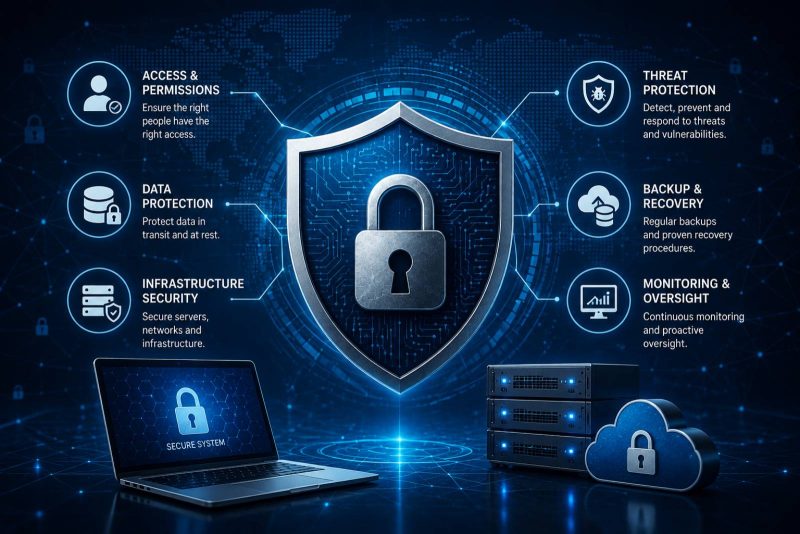
This includes the application and server infrastructure, user accounts and permissions, secure communication, data protection, updates, backups, monitoring, and the ability to recover systems when necessary.
Users and administrators should only be given the access they actually need. Data should be appropriately protected both in transit and at rest, while applications, operating systems, frameworks, CMS platforms, and other components need to be maintained and updated in a timely manner.
Backups are a good example of why security is more than an individual technical feature. Having a copy of the data is not enough — we need to know what is being backed up, where those backups are stored, who can access them, and whether they can actually be used to restore the system.
The same applies to monitoring. Its purpose is not simply to check whether a server is running, but to identify problems early enough to respond before they have a significant impact on users or business operations.
Depending on the requirements of a project, infrastructure does not have to be limited to conventional hosting or cloud services. We design and implement in-house server solutions, including Proxmox virtualization, allowing services to be separated and resources to be managed more efficiently while implementing appropriate backup and recovery procedures.
This brings us back to the CIA triad: we protect data against unauthorized access and modification while also ensuring that systems remain available when they are needed.
Security in Everyday Work and Communication
Cybersecurity does not end at the server or when an application goes into production. The way we use systems and exchange information in our everyday work is also part of security.
Throughout a project, requirements, technical documentation, issue reports, and other information relevant to the business are continuously exchanged. Project communication should therefore be organized and accessible to the people for whom it is intended.
In our projects, we use Redmine for task management, support, and project communication, keeping relevant information and project history within a controlled project environment. The tool itself is not a guarantee of security — how it is configured, where it is hosted, how it is maintained, and who has access to it are equally important.
The same principle applies to user accounts, documentation, server access, and external services. Access should be removed when it is no longer required, while sensitive information should not be unnecessarily distributed across multiple communication channels.
Security is therefore not only a matter of technology. People, responsibilities, and working practices are just as important as applications and infrastructure.
Security Management and Standards
As IT systems and organizations become more complex, individual technical measures are no longer sufficient. Risk, responsibilities, quality, business continuity, and information security need to be managed systematically.
International standards play an important role in this context. Standards particularly relevant to these areas include ISO 9001 for quality management, ISO 22301 for business continuity management, and ISO 27001 for information security management. ISO 22301 focuses on an organization’s ability to prepare for disruptions, respond to them, and recover.
Certification against a particular standard and the adoption of good practices are not the same thing. A certificate is not a claim that a security incident will never occur; it confirms that an appropriate management system has been established and independently assessed within a defined scope.
We will explore standards and certification in more detail separately. In the context of cybersecurity, their fundamental message is particularly relevant: security is not a collection of unrelated technical solutions, but a process that needs to be systematically managed.
Conclusion
Cybersecurity is not a single technology or a label added to a finished project. It begins with responsible planning, continues through development and infrastructure, and remains part of the everyday use, communication, and maintenance of a system.
The objective is not to claim that a system is completely secure. It is to understand the actual risks and apply measures appropriate to the data, systems, and business we are protecting.
If you are developing a new IT solution or want to improve the security of an existing application or infrastructure, talk to us about your requirements and possible solutions.